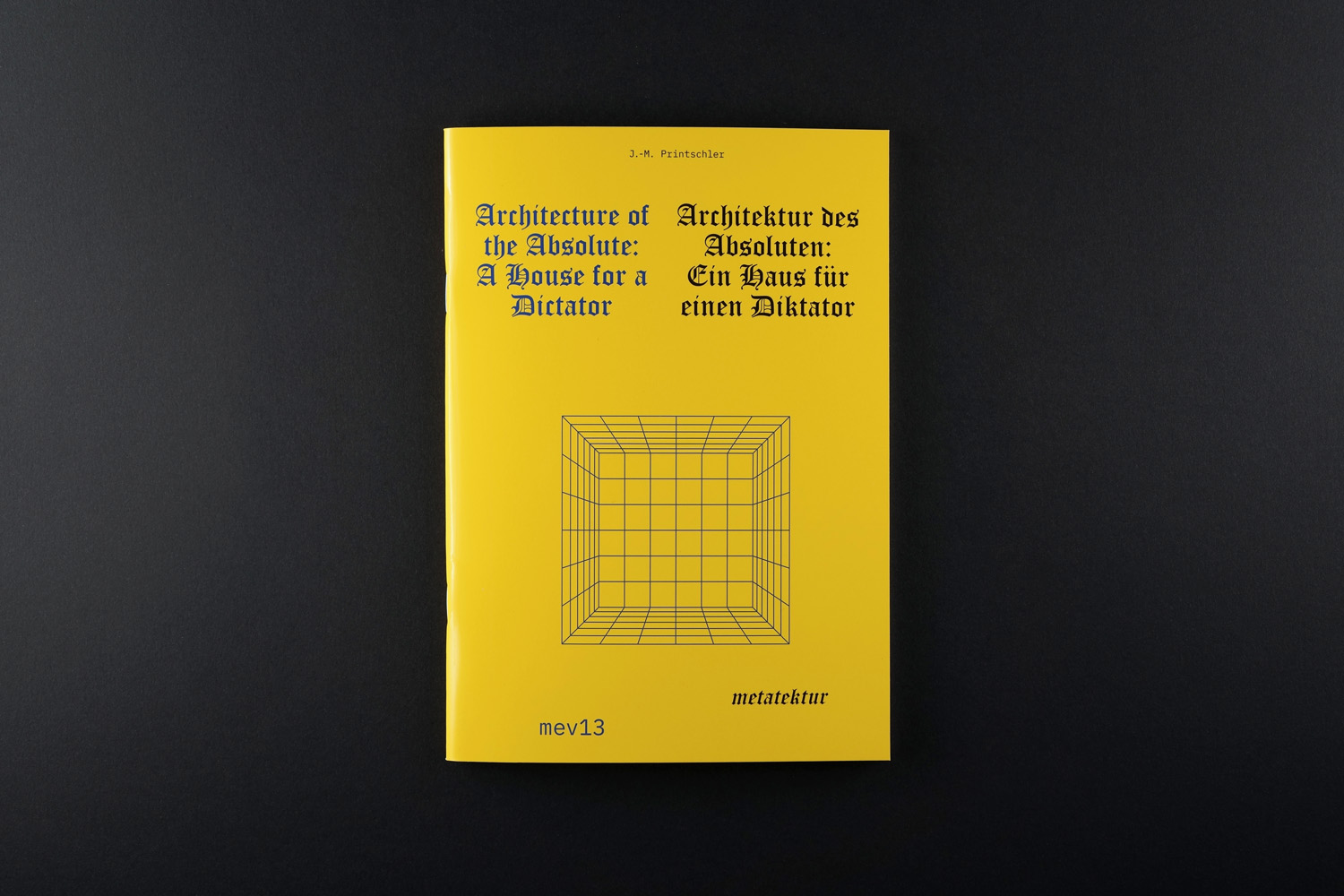
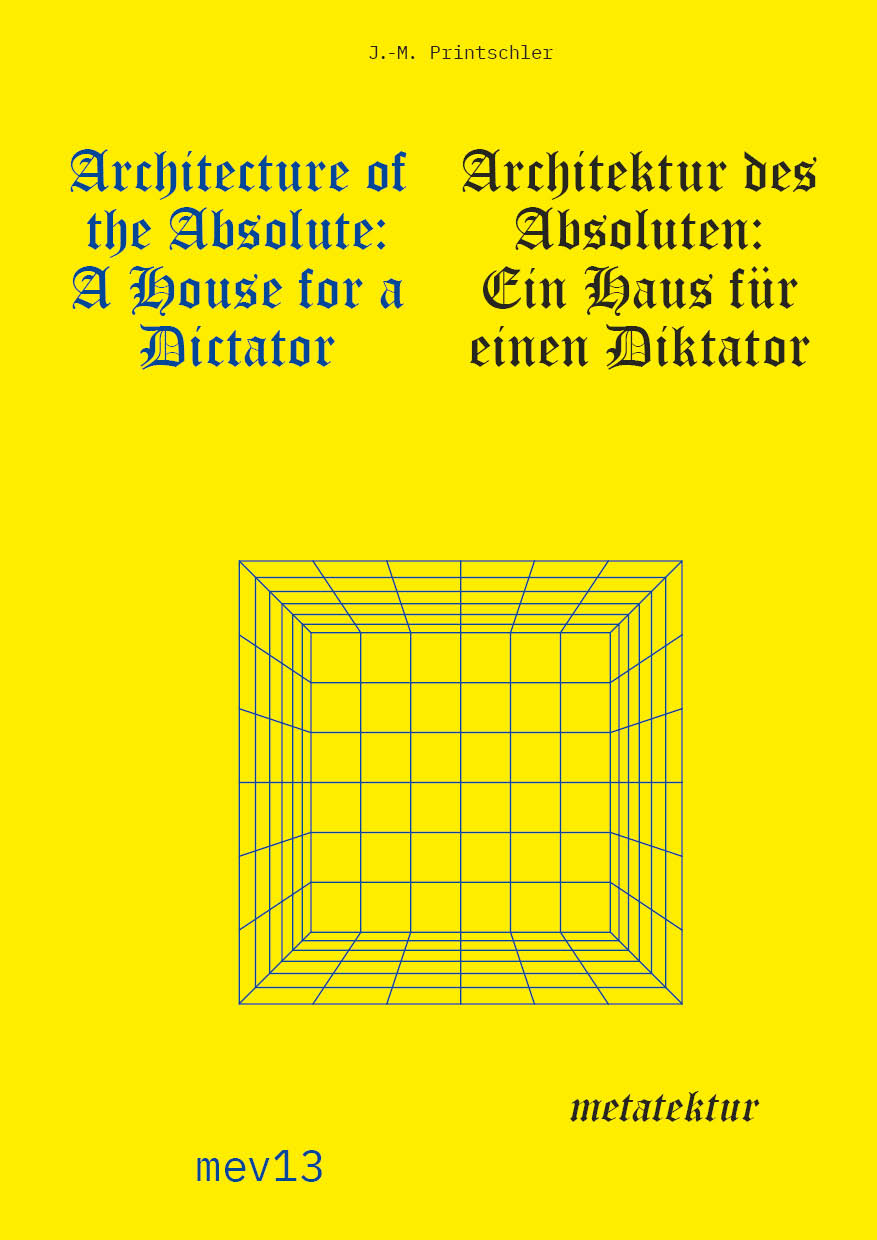
Architecture of the Absolute: A House for a Dictator (Josef-Matthias Printschler, Metatektur, 2026) is conceived as a publication of text and graphics which approaches architecture not as a constructed object, but as a semantic force and a spatial-atmospheric condition.
Departing from the ostensibly concrete design problem of a 'house for a dictator', the book uses this scenario as an analytical testing ground. Rather than proposing a building, the publication—conceived as an essayistic and speculative thought experiment—investigates how spatial-atmospheric configurations can produce, shift, or dissolve authority.
Written in dense, rhythmically structured language, the text articulates a conception of space, describing architecture as a resonant body, a projection surface, and an epistemic machine that generates knowledge about authority, while simultaneously exposing its fragility. How does space manifest as a medium of power? Can space simultaneously emerge as a field of its own destabilization?
Architecture of the Absolute: A House for a Dictator interweaves architectural, theoretical, philosophical, and perceptual perspectives. It reads space as both a carrier of political effect and an unstable structure that resists definitive fixation.
Critical Overview Editorial text by the editors
In Architecture of the Absolute: A House for a Dictator, Josef-Matthias Printschler offers a deliberately difficult-to-categorize publication that shifts between experimental architectural theory and philosophical essay. While the book begins with an apparently concrete design problem—building a house for a dictator—it quickly reveals this to be a heuristic figure. The text consistently avoids offering an architectural solution, instead shifting the question into the realm of spatial semantics and atmospheric effect.
Through his dense, rhythmically structured writing, Printschler unveils an interpretation of space in which architecture is viewed as a resonant body, a projection surface and an epistemic machine. Notably, there is a consistent shift from object to effect, with spaces appearing not as static constructs, but as operative fields in which authority sedimentates atmospherically.
The publication formally employs a theory-laden language that clearly situates itself within the tradition of continental architectural philosophy. References to the works of Leibniz, Kant and Piranesi are woven into the structure of the argument. This methodological consistency lends the text remarkable coherence, but also demands a high degree of attentiveness from the reader. Readers expecting a more conventional architectural theoretical argument may find the elliptical and occasionally circular progression of ideas challenging.
However, this is one of the work’s strengths; the publication performs what it describes. Architecture appears not only as the object of analysis, but also as a spatial experience enacted within the text through repetition, condensation, and atmospheric charge. While this strategy is risky, it is convincing in execution.
One critical point to note is that the theoretical density sometimes comes at the expense of conceptual precision. At certain points, the text approaches the threshold of metaphorical overdetermination, where the analytical and poetic registers begin to blur. For readers unfamiliar with architectural theory, this may reduce accessibility. The political dimension of the 'dictatorship' largely remains at the level of spatial semantics, with a more explicit engagement with the concrete practices of power deliberately avoided.
As a compact booklet, text-and-graphics publication, the project presents an intriguing material tension: the limited size effectively contrasts with the absolute claim of the title. The graphic integration supports the speculative nature of the work without becoming illustrative.
Overall, Architecture of the Absolute is best understood as a precisely staged thought experiment rather than a closed theory. Rather than offering new typologies or historical case studies, the publication broadens the discourse on architecture and power by consistently shifting the focus towards perception, atmosphere and the semantic operations of space.
It is a demanding, deliberately marked, and dense work that productively positions itself between architectural theory and artistic research. For readers interested in the political semantics of space, Architecture of the Absolute constitutes a rigorous and distinctive intervention within the discourse.